
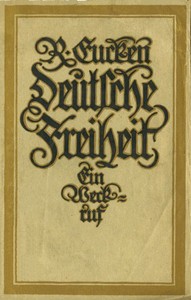
Deutsche Freiheit: Ein Weckruf by Rudolf Eucken
Published in 1914, just as Europe was about to tear itself apart, Rudolf Eucken's Deutsche Freiheit: Ein Weckruf is not a story with characters and a plot. Think of it as an argument, a passionate speech frozen in time. Eucken was a Nobel Prize-winning philosopher, and this book is his fevered attempt to grab his country by the shoulders and give it a shake.
The Story
The 'story' here is Germany's. After unifying in 1871, the nation became an economic and military powerhouse. But Eucken saw a problem. He believed this new, powerful Germany was chasing the wrong kind of freedom. The country was obsessed with material wealth, technical skill, and state power. He called this 'outer' freedom. Eucken argued that true, lasting freedom—'inner' freedom—comes from something deeper. It comes from a rich cultural life, deep philosophical and religious thought, and a strong sense of personal and national ethics. The book is his warning: if Germany only focuses on being strong and efficient, and forgets its soul, it will create a hollow, dangerous version of itself.
Why You Should Read It
Here’s the wild thing: even though he’s talking about early 1900s Germany, it feels familiar. Swap out a few specifics, and he could be talking about any modern nation wrestling with its values. Are we defined by our GDP and military, or by our ideas, our art, and how we treat people? Eucken’s fear was that without this moral core, 'freedom' just becomes permission for the powerful to do what they want. Reading it with the knowledge of the World Wars that followed is a haunting experience. You see the warning lights flashing, clear as day. It’s a masterclass in how intellectuals try to steer public debate, and a sad lesson in how often those warnings go unheeded.
Final Verdict
This isn't a beach read. It's for the curious thinker. It's perfect for history buffs who want to get inside the mind of pre-WWI Germany, or for anyone interested in the big, never-ending questions about what makes a society good and healthy. If you like books that make you connect the past to the present, that challenge you to think about what 'freedom' really means beyond politics, you’ll find this short, intense book incredibly rewarding. Just be prepared—it’s a sobering look in the mirror, for any nation.
This masterpiece is free from copyright limitations. You can copy, modify, and distribute it freely.
Donald Harris
2 months agoA brilliant read that I finished in one sitting.
Mark Lee
1 year agoTo be perfectly clear, the arguments are well-supported by credible references. I would gladly recommend this title.
George Clark
11 months agoJust what I was looking for.
Ashley Taylor
1 year agoGreat read!

David Moore
1 year agoIt’s rare to find such a well-structured narrative nowadays, the cross-referencing of different chapters makes it a great study tool. This is a solid reference for both beginners and experts.