
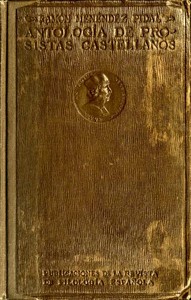
Antología de prosistas castellanos by Ramón Menéndez Pidal
Let's be clear from the start: this isn't a beach read. Antología de prosistas castellanos is a specialized tool, but for the right person, it's a fascinating one. Compiled by Ramón Menéndez Pidal, a giant in the field of Spanish philology, this book gathers key prose texts from the Middle Ages. Think of it as a curated museum exhibit for the written Spanish word.
The Story
There's no plot in the traditional sense. Instead, the 'story' is the evolution of the Spanish language itself. The book presents excerpts from foundational texts written between the 12th and 15th centuries. You'll find chunks of the Fuero Juzgo (a Visigothic law code), historical chronicles that shaped national identity, and early literary prose. It's not a continuous narrative but a series of snapshots. Each text is a piece of evidence, showing how people used language for law, history, and storytelling. Reading it is like watching a language learn to walk, then run.
Why You Should Read It
The magic here is in the direct contact. You're not reading about Old Spanish; you're reading it. You see the spelling variations, the sentence structures, the words that have vanished or changed meaning. It makes the past feel immediate and tangible. For me, the most compelling sections were the early chronicles. The way they mix fact, legend, and a clear political agenda is utterly gripping. You see history being constructed, not just recorded. It strips away the polished veneer of modern history books and shows the raw material.
Final Verdict
This book is a niche gem. It's perfect for students of Spanish linguistics, medieval history enthusiasts, or writers curious about the deep roots of their language. It's also great for advanced Spanish learners who want a serious challenge. If you're looking for a casual novel, look elsewhere. But if you have a scholarly itch to see the authentic, unvarnished beginnings of Spanish literature and thought, this anthology is an essential and rewarding deep dive. Keep a good dictionary (and maybe a history reference) nearby—you'll need them.
You are viewing a work that belongs to the global public domain. Distribute this work to help spread literacy.
Sarah Harris
11 months agoThe digital index is well-organized, making research much faster.
Nancy White
6 months agoI was particularly interested in the case studies mentioned here, the cross-referencing of different chapters makes it a great study tool. This is a solid reference for both beginners and experts.
John Anderson
1 year agoA sophisticated analysis that fills a gap in the literature.
Daniel Nguyen
1 year agoThanks for the recommendation.






James Williams
1 year agoVery satisfied with the depth of this material.