
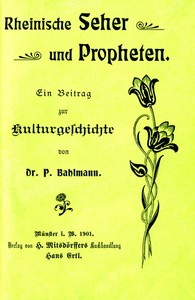
Rheinische Seher und Propheten: Ein Beitrag zur Kulturgeschichte by Paul Bahlmann
Published in 1909, Paul Bahlmann's Rheinische Seher und Propheten is a work of regional history with a unique focus. Instead of chronicling wars or politics, Bahlmann turned his attention to the intangible: the stories of individuals known for prophetic gifts within the Rhineland.
The Story
There isn't a single narrative plot. Bahlmann acts as a collector and analyst. He scoured local archives, church records, and folk traditions to document cases of 'seers'—both men and women—primarily from the 1700s and 1800s. The book profiles these individuals, describing their backgrounds, the nature of their supposed visions (often dreams about deaths, disasters, or lost items), and how they were perceived by their villages. We see the miller's daughter known for finding lost cattle through her dreams, the pious layman whose warnings were heeded by local clergy, and the many others who occupied a curious space between respected community member and local mystic. Bahlmann presents their stories not as proof of the supernatural, but as social facts to be examined.
Why You Should Read It
What grabbed me was the book's quiet humanity. Bahlmann avoids sensationalism. Reading it, you get a palpable sense of daily life in these towns. The 'prophets' weren't usually grand figures; they were neighbors. Their 'power' often lay in offering reassurance, solving practical problems, or reinforcing moral and religious norms. The book becomes a study in how communities process uncertainty. Before 24-hour news and weather apps, these seers provided a framework for understanding the unexplained. It’s less about believing in ghosts and more about understanding the human need for narrative and comfort. Bahlmann’s tone is that of a respectful local historian, preserving a fading part of his region's character. You finish it feeling like you’ve peeked into the mental world of a past society.
Final Verdict
This is a niche but rewarding read. It's perfect for history buffs who enjoy social and cultural history from the ground up, and for anyone interested in folklore or the history of popular belief. Because it's an older academic work (and in German, though translations exist), it requires a bit of patience—it's not a fast-paced novel. But if you're curious about how ordinary people grappled with the unknown in the not-so-distant past, Bahlmann's collection offers a unique and thoughtful window. It’s for the reader who finds fascination in the quiet corners of history.
This content is free to share and distribute. It serves as a testament to our shared literary heritage.
Elizabeth Wilson
8 months agoA sophisticated analysis that fills a gap in the literature.
Linda Ramirez
9 months agoFrom the very first page, the atmosphere created is totally immersive. One of the best books I've read this year.
Ethan Gonzalez
7 months agoHaving read this twice, it challenges the reader's perspective in an intellectual way. Exceeded all my expectations.
Christopher Lee
3 months agoFinally found time to read this!









Jessica Taylor
6 months agoThis digital copy caught my eye due to its reputation, the inclusion of diverse viewpoints strengthens the overall narrative. Truly a masterpiece of digital educational material.