
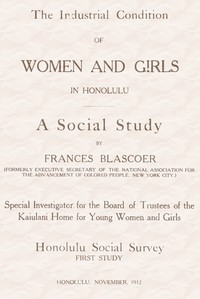
The Industrial Condition of Women and Girls in Honolulu: A Social Study by Blascoer
Published in 1912, this book is the result of a formal investigation, but it reads like a series of urgent, firsthand accounts. Frances Blascoer was hired by a group of concerned citizens to systematically study the conditions of female wage-earners in Honolulu. She didn't just look at statistics; she went to the factories, the laundries, and the garment workshops. She talked to the women and girls—many of them teenagers—on their breaks and in their cramped living quarters.
The Story
There isn't a traditional plot, but there is a clear narrative: it's the story of a city's economic growth built on the backs of its most vulnerable. Blascoer lays out the facts. She shows us the long hours (often 10 hours a day, 6 days a week), the shockingly low pay that barely covered rent and food, and the dangerous, exhausting work. We meet Japanese and Portuguese immigrants, Native Hawaiian women, and others doing 'women's work'—sewing, laundering, packing fruit—for wages that kept them in poverty. The book details everything from the dust in the mattress factories to the lack of clean drinking water at work sites. The central conflict is between the prosperous image of Honolulu and the hidden struggle of the workforce making that prosperity possible.
Why You Should Read It
This book is powerful because it gives a megaphone to people history usually forgets. Blascoer’s method is straightforward: here is what I saw, here is what the women said, here are the numbers. That simplicity makes it devastating. You can't brush it off as opinion. It connects directly to conversations we're still having today about fair wages, workers' rights, and immigration. Reading it, I kept thinking about how these women's labor literally built modern Hawaii, yet their stories were nearly erased. It’s a tough but important read that replaces postcard clichés with human reality.
Final Verdict
Perfect for readers of social history, anyone interested in labor rights, or people fascinated by the real, complex stories of Hawaii beyond the tourism brochures. It's not a beach read; it's a necessary, eye-opening record. Think of it as essential background reading to truly understand the islands. If you enjoyed books like ‘The Jungle’ for its exposé feel or any work that uncovers the hidden layers of a city, you'll appreciate Blascoer's clear-eyed and compassionate report.
There are no legal restrictions on this material. You can copy, modify, and distribute it freely.
Andrew Gonzalez
1 year agoI didn't expect much, but it manages to explain difficult concepts in plain English. Exactly what I needed.
Edward Rodriguez
7 months agoThis is one of those stories where the depth of research presented here is truly commendable. A valuable addition to my collection.



Ashley Clark
2 months agoAmazing book.