
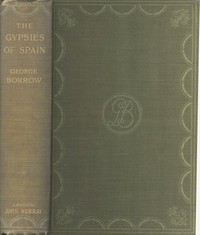
The Zincali: An Account of the Gypsies of Spain by George Borrow
First published in 1841, The Zincali is George Borrow's account of the Romani people (he uses the term 'Gypsies') in Spain. Borrow wasn't an armchair anthropologist. He traveled across the country as a missionary for the Bible Society, but his real mission seemed to be getting as close as possible to the Romani communities. The book is less a linear story and more a collection of his experiences, observations, and the stories he gathered. He details their arrival in Spain, their customs, their complex social rules, and, most famously, their language, Caló—a mix of Romani and Spanish. He shares tales of fortune-tellers, smugglers, and fiery confrontations with local authorities. The 'plot,' such as it is, follows Borrow's own journey of immersion, from being an outsider to gaining a level of trust that few foreigners ever achieved.
Why You Should Read It
You should read this not for a perfectly accurate, modern ethnography, but for the sheer force of Borrow's personality and the rare glimpse he provides. It's a time capsule. You feel the dust of the Spanish road and the tension in a crowded marketplace. Borrow paints vivid portraits of the people he meets, and his passion for their language and lore is contagious. He clearly admires their resilience and spirit, even when he disapproves of their actions. Reading it today is a fascinating exercise. You get this incredible primary source material, but you also have to read between the lines, aware of Borrow's Victorian mindset and his missionary agenda. It makes you an active participant, sifting the observations from the judgments.
Final Verdict
This book is perfect for readers who love immersive travel writing from a bygone era and have an interest in Romani history and culture. It's a must for anyone curious about how 19th-century Europeans viewed 'the other.' If you enjoy books where the author's own adventures are as compelling as the subject matter, you'll be hooked. Just be prepared: this isn't a politically correct, sanitized view. It's raw, biased, passionate, and completely unforgettable. Approach it as a fascinating historical document and a ripping good travel yarn, and you'll find it incredibly rewarding.
Legal analysis indicates this work is in the public domain. Enjoy reading and sharing without restrictions.
Michelle Thompson
1 year agoAmazing book.
John Martin
1 year agoWithout a doubt, it challenges the reader's perspective in an intellectual way. I couldn't put it down.
Kenneth Clark
2 years agoVery helpful, thanks.
Logan Clark
9 months agoEnjoyed every page.







Margaret Nguyen
1 year agoAfter finishing this book, it manages to explain difficult concepts in plain English. Exceeded all my expectations.